AI & Data 22 min read 2026-11-14
Can AI Actually Trade? 7 Months of Lessons Building Cortex Finance

Yiğit Can H.
Full-Stack Developer

Table of Contents
For the past three years, almost every software engineer and investor has been asking some version of the exact same question: Can artificial intelligence actually trade? In an era where large language models analyze sprawling codebases, synthesize hundreds of pages of research in seconds, and spot patterns faster than any human ever could, it was inevitable that our curiosity would spill over into financial markets. From viral "I gave an AI $100 for a week" videos to institutional quant debates, everyone is chasing the same mystery.
I ended up searching for that answer not from inside the finance world, but indirectly from my own kitchen — software engineering. What started as an AI-assisted orchestration backbone I had built for a completely unrelated product gradually turned into a hobby trading experiment, and over time evolved into Cortex Finance. Starting from absolute zero market experience, integrating every major LLM provider on the market, wiring my Binance wallet directly into the gateway, and grinding on the system day and night for seven months taught me sobering lessons about both how AI actually thinks and how unforgiving live markets really are.
In this article, I want to set marketing hype aside and share what broke, what worked, and where AI genuinely belongs in a trading architecture — backed by real screenshots and architectural patterns from Cortex Finance.
Warning
Nothing in this article constitutes financial or investment advice. Every detail and screenshot shared here reflects the personal engineering notes of a software developer who started with zero finance background while building AI orchestration, mechanical triggers, and risk guardrails. Any decision or risk taken in financial markets belongs strictly to the individual operator.
Zero Interest in Markets, ADHD, and Turning a Hobby Backbone into a Trading System
To be completely candid, as a software developer I never had the slightest interest in stock markets or cryptocurrencies. Whenever people around me talked about candlestick patterns, support and resistance lines, leverage ratios, or altcoin portfolios, it all sounded like distant background noise to me.
On top of that, because I live with ADHD, sitting down and forcing myself through sheer willpower to study a subject that does not genuinely spark my curiosity is close to impossible. Developers with ADHD know this dynamic intimately: a five-minute tutorial on a topic you do not care about feels like climbing a concrete wall, whereas a problem that hooks your architectural curiosity lets you design systems for fourteen hours straight without noticing the clock.
That intersection was my turning point. The moment I combined a domain I had never cared about with the craft I love most — software architecture and AI systems engineering — the entire equation flipped. I took the multi-provider LLM gateway, workflow engine, and knowledge-base assistant I had originally built for another project and asked: "What happens if I point this entire backbone at live market data and order execution?" Overnight, trading stopped looking like a dry finance textbook and became one of the hardest distributed-systems puzzles I had ever touched.
The Naive Engineer Hypothesis on Day One
When I wrote the first finance modules, my underlying assumption as a programmer was remarkably naive: With the analytical speed and computational capacity of modern AI models, this should be straightforward.
On paper, the logic felt bulletproof. Why do human traders lose money? They panic, get greedy, lose sleep, can only watch two or three charts at once, and freeze when they should cut a losing position. An AI has no ego, never gets tired, can digest dozens of indicators in milliseconds, and evaluates probabilities dispassionately. I assumed that once I piped clean market data into top-tier frontier models, the problem would largely solve itself.
Starting with zero trading knowledge, it did not take long for live market reality to dismantle that assumption piece by piece.
Scope Locks to Survive the ADHD Fog
When an engineering puzzle hooks an ADHD brain, a second trap immediately appears: opening five new fronts at once. One day you want to build a new indicator family, the next day integrate three more exchanges, and the day after build an autonomous self-rewriting bot.
To keep myself from drifting into endless side-quests, I brought the strict task lifecycle and guardrail discipline from my open-source Agentic Workflow system directly into the root of Cortex Finance. Every coding session loads an explicit "North Star" document (GOAL.md) enforced by scope locks: one exchange ecosystem (Binance futures and spot), one primary objective (strategy quality, mechanical trigger reliability, and safe order lifecycle), and zero phase-jumping without measured proof. Without those guardrails, seven months of work would have produced ten half-baked prototypes instead of one cohesive platform.
Integrating Every Major Model Provider — and Hitting a Wall
I did not want to base my conclusions on a shallow chat wrapper around a single model. Inside Cortex Finance, I integrated every major frontier and fast inference provider behind a single canonical model catalog and Fastify gateway:
- OpenAI (GPT and Codex model families)
- Anthropic (Claude Opus and Sonnet series)
- Google (Gemini series)
- xAI (Grok models)
- DeepSeek and additional CLI/API agent surfaces
I wired up token-level cost accounting, automatic provider failover, and native MCP tool access, then connected my Binance wallet (starting with isolated environments across paper and Testnet alongside dual-gated Mainnet infrastructure) to test all of them side by side.
In the early weeks, the results were pure frustration.
Whenever I asked models to evaluate the market and commit to concrete trade parameters, I ran into one of two walls: either they flatly refused to engage with trading decisions, or they hid behind an overly protective shield of vague hedging. Sentences like "If momentum continues above resistance, price could rise, though renewed selling pressure may push it lower; please do your own research" are technically impossible to falsify — and operationally useless.
Why Models Try to Protect You from Yourself
At first, I treated this evasiveness as an annoying prompt-engineering obstacle. As I studied how different models responded under uncertainty, however, I realized something important: That behavior was actually supposed to be there.
To work effectively with AI, we have to understand how frontier models are aligned. Through safety post-training (RLHF), models are explicitly shaped to protect everyday users — and their savings — from blind financial ruin. When you read between the lines of those cautious responses, the models are quietly repeating an uncomfortable statistical truth:
Without a verified statistical edge, post-fee positive expectancy, and strict risk ceilings, trying to guess short-term price direction in a chat window is indistinguishable from flipping a coin.
The model's hesitation was not a bug; it was a rational defense mechanism. Asking a raw language model "Should I buy ETH right now?" without structured tools, historical validation, or invalidation rules is no different from asking it to read tea leaves.
Separating Legal Disclaimers from Analytical Utility
The first major product breakthrough in Cortex Finance came from cleanly separating legal responsibility boundaries from analytical task definitions. Early on, we noticed a subtle anti-pattern that even crept into software tests: conflating "This platform is not a licensed investment advisor" with prompt instructions that effectively told the model "Never formulate a concrete thesis."
Those two concerns belong on completely separate layers:
- Legal boundary: Transparently informs the operator on every surface that Cortex is not licensed financial advice and that capital risk belongs strictly to the user.
- Analytical contract: Within the user's explicit risk ceilings, requires the model to read structured market data tools and output a falsifiable plan — exact trigger conditions, invalidation levels, and risk parameters rather than vague prose.
Once we separated those layers, models stopped speaking in riddles and started producing structured strategy objects. That immediately unlocked the real test: now that the models were formulating clear plans, could they actually survive contact with a live order book?
Book Smarts vs. Street Smarts: The Zero-Experience Intern Metaphor
Whenever we interact with an eloquent system, human instinct pushes us to treat it as an autonomous subject — an independent decision-maker capable of owning an outcome end to end.
Large language models do not have instincts built for that role. They are assistants, and they are only as effective as the light you hold in front of them. Point your flashlight at the wrong wall, and they will illuminate the wrong problem in remarkably convincing prose.
Across seven months of testing every major model against live crypto market structure, one analogy captured the reality better than any technical paper:
Imagine hiring a brand-new intern at your company. This intern has memorized every textbook ever written on quantitative finance, macroeconomics, technical indicators, and probability theory. They work at lightning speed, stay dynamic around the clock, and show up at 3:00 AM with peak motivation. Ask them any terminology question and you get a graduate-level explanation in two seconds. Yet they have zero days of real-world trading experience.
That experience gap is the single biggest reason AI models fail to live up to the "autonomous trading genius" myth. There is an old Turkish proverb — "Çok okuyan mı bilir, çok gezen mi?" ("Who truly knows best: the one who reads the most, or the one who travels and lives through it?"). An LLM is the ultimate reader: it knows every formula from RSI, ATR, and funding rates to order-book imbalance and spot-perp basis spreads. What it has never lived through is watching a 300-millisecond liquidity wick sweep a textbook stop-loss before reversing, or watching exchange taker fees quietly bleed a "high-win-rate" scalping thesis dry.
| Dimension | The Well-Read Intern (Raw LLM) | Live Market Friction (Street Reality) | Cortex Finance Engineering Countermeasure |
|---|---|---|---|
| Price action triggers | Treats any intra-bar touch below support as a clean breakout | Sub-second liquidity wicks hunt stops and snap right back | Wick-resistant confirmation engine evaluating closed-candle closes only |
| Cost awareness | Counts gross price movement between entry and exit as profit | Entry/exit taker fees, spread, slippage, and funding eat thin edges | Real-time fee-adjusted net accounting and wallet-level reconciliation |
| Exception handling | Assumes every dispatched API order fills cleanly as requested | Orders expire, cancel, partially fill, or drop during network jitter | Explicit state machines, exchange order reconciliation, and fire-recovery services |
| Self-evaluation | Mistakes a three-day winning streak for permanent alpha | A rising tide lifts every long trade; skill is only what beats beta | Fixed-horizon post-entry tracking and BTC beta-adjusted return analysis |
The screenshot below comes straight from Cortex Finance's Positions (Pozisyonlar) command center running on Testnet. Even in a single view, you can see how the UI was shaped around real market friction rather than textbook theory:
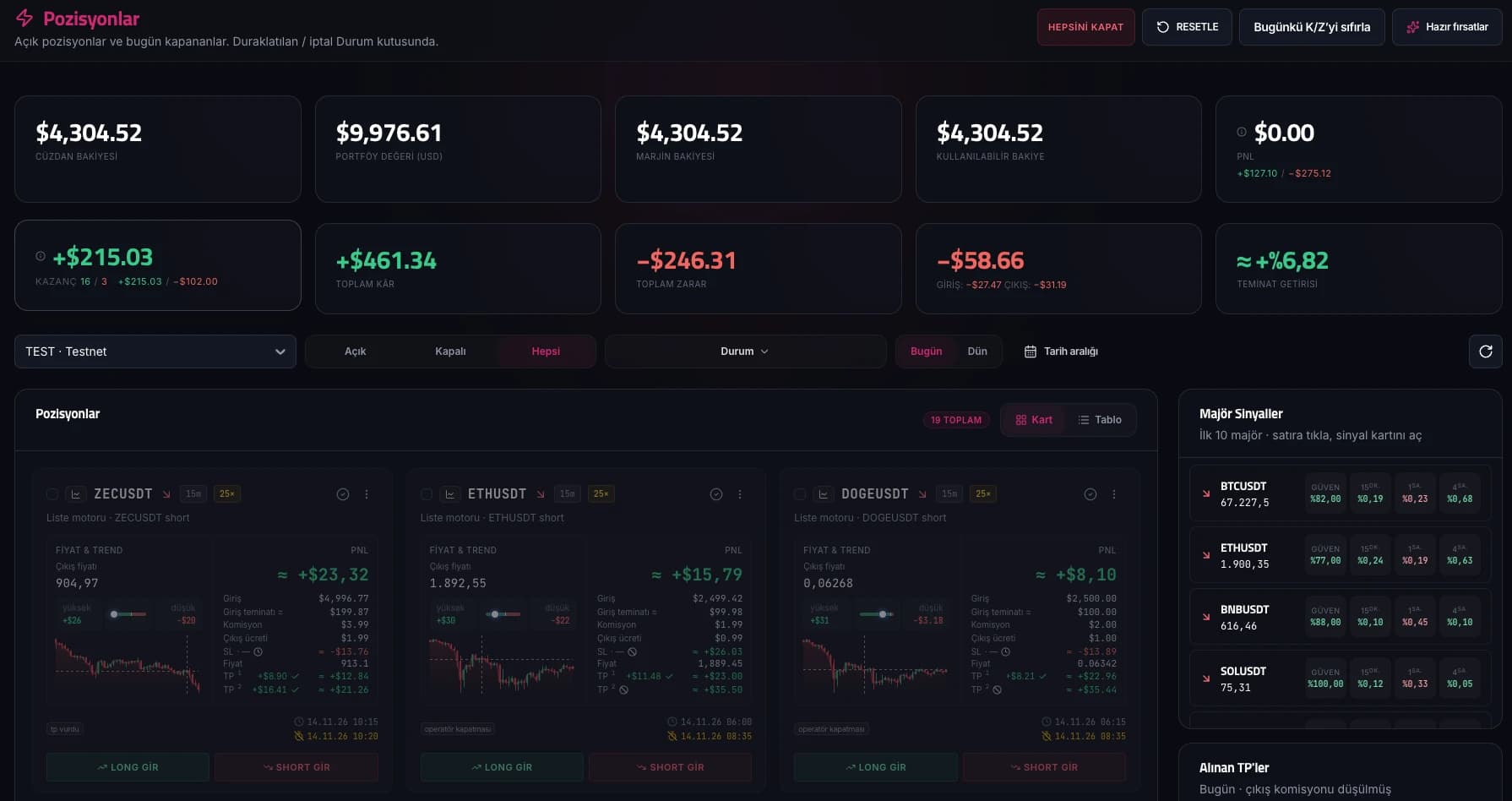
Look closely at the summary cards along the second row: the dashboard refuses to flatter the operator with gross wins (+$461.34 or a 16 / 3 win ratio) alone. Right beside them sits an unmistakable -58.66 USD fee card breaking down entry commissions (-$27.47) and exit commissions (-$31.19). An inexperienced model will happily propose tight intraday setups all day long without feeling how quickly exchange fees devour theoretical gains. Respecting fee drag is not something you learn from a prompt — you learn it when real ledger math confronts you on screen.
Inside Cortex Finance: Separating the Brain from the Muscle
Once I accepted that LLMs cannot act as standalone "trader subjects" — yet excel as tireless analytical co-pilots when bounded properly — the architecture of Cortex Finance clicked into place.
In our internal product doctrine, we describe Cortex not as an artificial human trader, but as a mechanical exoskeleton — much like a Jaeger in Pacific Rim. The language models sit inside the cockpit as analytical pilots scanning market structure and drafting plans, while every tendon that touches the exchange consists of deterministic TypeScript services.
Asking a chatbot "Should I buy now?" and firing an impulsive market order from chat is an anti-pattern we deliberately avoid. Instead, the core execution pipeline strictly follows Strategy → Mechanical Trigger → Guarded Order.
Wick Traps and Closed-Candle Confirmation
During my first few months starting from zero trading knowledge, nothing burned more test setups than intra-candle fakeouts. A model would identify a perfectly reasonable breakdown level, price would stab through that level on a violent two-second wick, an order would fire immediately, and before the 15-minute bar even closed, price would snap back and hit the stop-loss.
To our "well-read intern," the condition "Did price cross below 911.58?" evaluated to true. To an experienced market operator, an unclosed wick is often just a liquidity sweep. Turning that painful lesson into deterministic code produced our Closed-Candle Confirmation (Kapanış Teyidi) rule and setup-bar snapshot discipline:
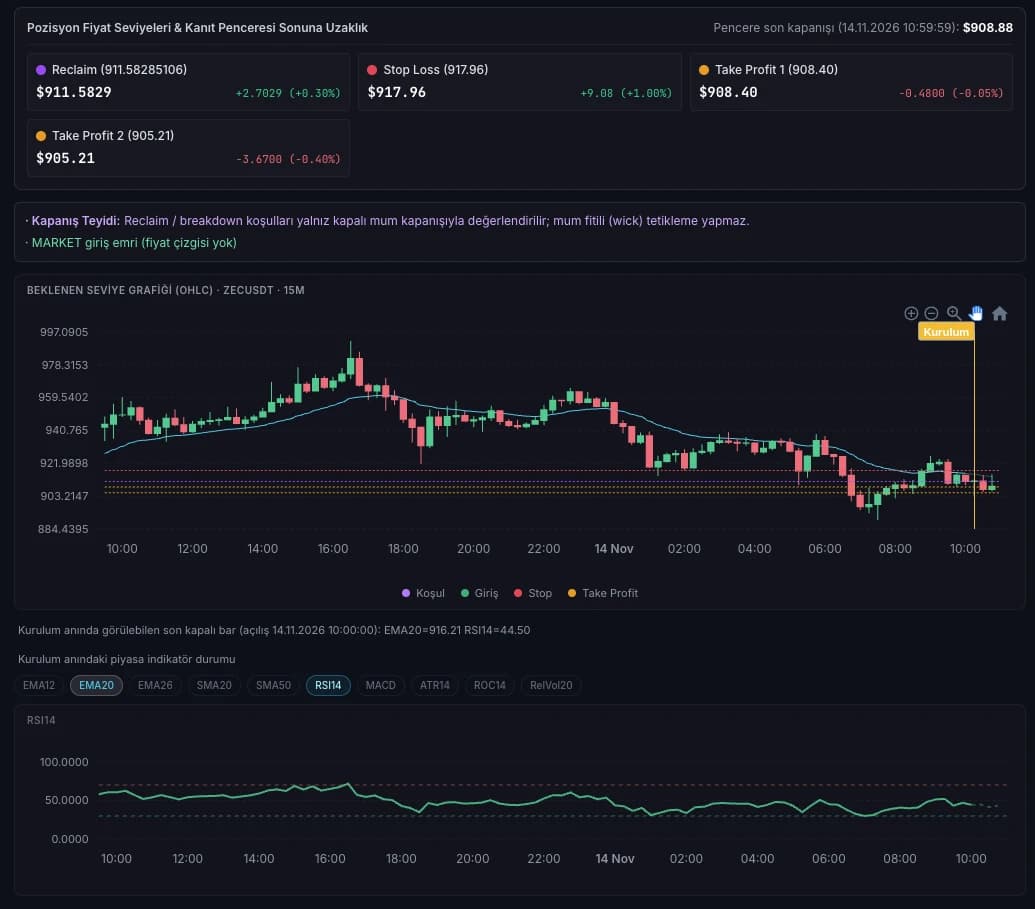
Two small details in that ZECUSDT 15-minute chart represent months of trial and error:
- Closed-candle confirmation: As highlighted in the purple rule banner (Kapanış Teyidi), reclaim and breakdown conditions are evaluated strictly on closed-bar prices; intra-candle wicks never trigger entries.
- Frozen setup-bar provenance: Beneath the chart, the exact indicator state visible on the last closed bar at setup time (
EMA20=916.21 RSI14=44.50at10:00:00) is permanently recorded. That eliminates look-ahead bias when auditing closed trades later — we know down to the decimal what the engine saw before entry.
Order Lifecycles, Exchange Reconciliation, and Zero Silent Failures
As a developer, my biggest unfair advantage in this journey was being able to translate every operational scar into a deterministic software contract. From the outside, sending an order to the Binance API looks like a thirty-minute task. In practice, dispatching the initial HTTP request is barely ten percent of the engineering surface.
What happens when a conditional leg expires or gets cancelled on the exchange? What if Take Profit 1 fills, price reverses, and an orphaned stop order accidentally opens a reverse position? What if the gateway container restarts mid-flight right as a trigger fires? Or what if a model proposes a parameter tweak that looks brilliant in hindsight but degrades live expectancy?
In Cortex Finance, LLM integration is never allowed to mutate live risk thresholds or bypass money-path gates on its own. Every strategy revision goes through an independent multi-model review cohort, prospective out-of-sample (OOS) shadow evaluation, and an explicit human promotion gate. And before any order reaches an exchange endpoint, deterministic code enforces a multi-layered safety contract:
typescript
// Simplified Cortex Finance execution contract:// Models propose structured strategies and trigger conditions, while risk ceilings,// closed-candle confirmation, protective stops, and dual-key mainnet locks stay in code.interface ExecutionSafetyContext {environment: 'paper' | 'testnet' | 'mainnet';allowLiveExecution: boolean;liveTradingEnabledAt: string | null;killSwitchActive: boolean;withinOwnerRiskCeiling: boolean;closedCandleConfirmed: boolean;protectiveStopConfigured: boolean;}export function evaluateExecutionGate(ctx: ExecutionSafetyContext): {allowed: boolean;reason?: string;} {if (ctx.killSwitchActive) {return { allowed: false, reason: 'kill_switch_active' };}if (!ctx.withinOwnerRiskCeiling) {return { allowed: false, reason: 'risk_ceiling_exceeded' };}if (!ctx.closedCandleConfirmed) {return { allowed: false, reason: 'awaiting_closed_candle_confirmation' };}if (!ctx.protectiveStopConfigured) {return { allowed: false, reason: 'missing_protective_stop' };}if (ctx.environment === 'mainnet') {const dualGateOpen = ctx.allowLiveExecution && ctx.liveTradingEnabledAt !== null;if (!dualGateOpen) {return { allowed: false, reason: 'mainnet_dual_gate_locked' };}}return { allowed: true };}
From setup to final settlement, every position moves through an auditable state machine (ARMED → FIRED → CLOSED, shown in the Turkish UI as KURULU → ATEŞLENDİ → KAPANDI). The single-position audit view below illustrates how Cortex reconciles local records against exchange reality:
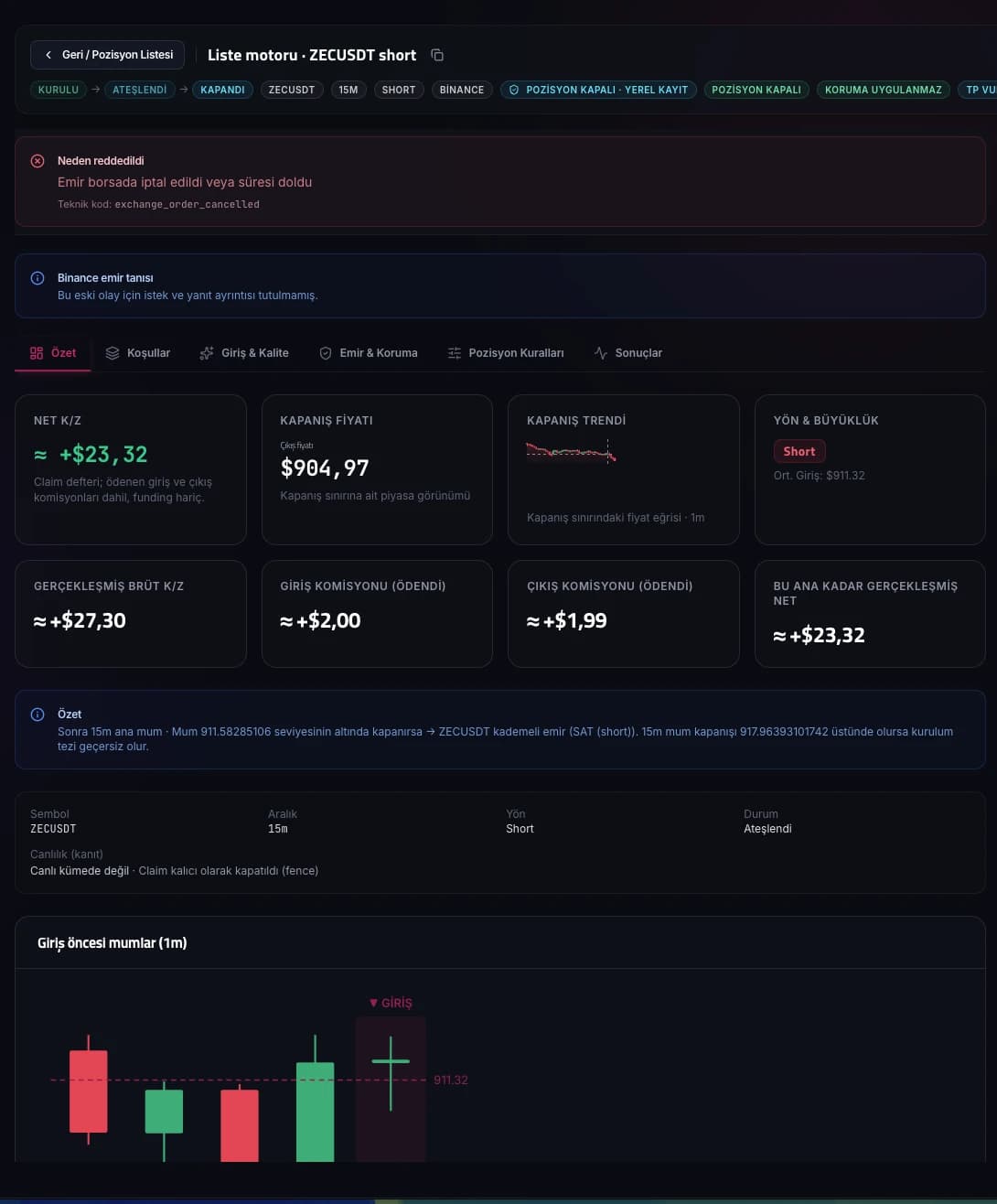
Notice three engineering disciplines working together on this screen:
- No silent exchange failures: The red diagnostic banner at the top (
exchange_order_cancelled) surfaces rejected or expired exchange orders immediately instead of letting failures vanish into server logs. - Fenced net accounting: Gross realized PnL (
+$27.30) minus paid entry commission ($2.00) and exit commission ($1.99) settles to+$23.32net, and the claim ledger is permanently fenced (Claim kalıcı olarak kapatıldı) so stale webhooks or retries can never double-count PnL or leave phantom exposure. - Falsifiable thesis record: The summary box locks in the exact rule ("If the 15m candle closes below 911.58285106 → staged SHORT; if a 15m candle closes above 917.96393101742, the setup thesis is invalidated"), paired with a 1-minute pre-entry micro-chart showing the exact execution bar.
The Honest 7-Month Verdict: Who Wins and Who Loses?
After seven months of relentless iteration, thousands of Testnet order cycles, and dozens of discarded hypotheses, here is my unfiltered conclusion:
First and foremost, AI models are not good at trading on their own.
I say this not after a weekend prompt experiment, but after seven months of dedicated systems engineering. If you have zero trading knowledge and no grasp of market structure or risk asymmetry, AI will never carry you forward by itself. If you dump all your expectations onto a model and expect it to print money on your behalf, I can guarantee that you will lose money.
Why? Because you cannot audit an intern in a domain you do not understand. When you do not know what invalidates a trade thesis or how volatility regimes break mean-reversion setups, your assistant's speed only helps you run faster in the wrong direction.
Does that mean succeeding with AI in trading is impossible? Not at all — provided three ingredients come together:
- Market and trading literacy: Understanding market regimes, risk-reward asymmetry, position sizing, and when not to trade at all.
- Knowing how to wield and interpret the right tools: Instead of asking raw price opinions in chat, feeding models quantitative backtests, volatility metrics, funding data, real-time news catalysts, and statistical edge validators — and knowing how to question their synthesis.
- And in my view, the biggest multiplier of all — software engineering skill: Translating rules into deterministic triggers, automated stop reconciliation, risk ceilings, and post-trade telemetry so human emotion stays out of the execution loop.
When you combine solid strategies, verified tools, and software discipline — positioning AI strictly behind you as an ASSISTANT rather than in front of you as an oracle — your odds of success can improve meaningfully. Even with a strong background in AI solutions and full-stack architecture, starting from zero trading literacy meant it took me seven full months of building and measuring before things began to click.
| Operator Profile | Role Assigned to AI | Typical Long-Term Outcome |
|---|---|---|
| Zero trading knowledge + zero coding skill | Autonomous "magic money box" | Inevitable drawdown and capital loss |
| Solid trading knowledge + raw ungrounded chat | Confirmation-bias sounding board | Persuasive narratives, inconsistent discipline |
| Zero trading knowledge + strong software/AI engineering | Instrument-first learning through guardrails and telemetry | Steep multi-month learning curve before structured results emerge |
| Trading literacy + quantitative tools + software engineering | Tireless, rule-bound analytical assistant | Highest leverage: protected capital and rising execution quality |
Month-7 Results, Continuity, and Refusing to Fool Yourself
By the end of month seven, I finally began seeing consistent, encouraging results across structured runs. And let me be completely upfront: even that is no guarantee.
The single hardest lesson in trading is continuity. Stringing together three strong days or watching a cumulative curve climb makes it dangerously easy to believe you have "cracked the code." Yet crypto market regimes shift without warning; a parameter set that harvests clean short-term moves all week can get chopped to pieces the moment liquidity thins out or a macro trend accelerates.
To keep myself honest, I built performance screens in Cortex Finance that do not merely ask "How much money did we make today?" — they interrogate whether those returns came from genuine skill or plain market drift:
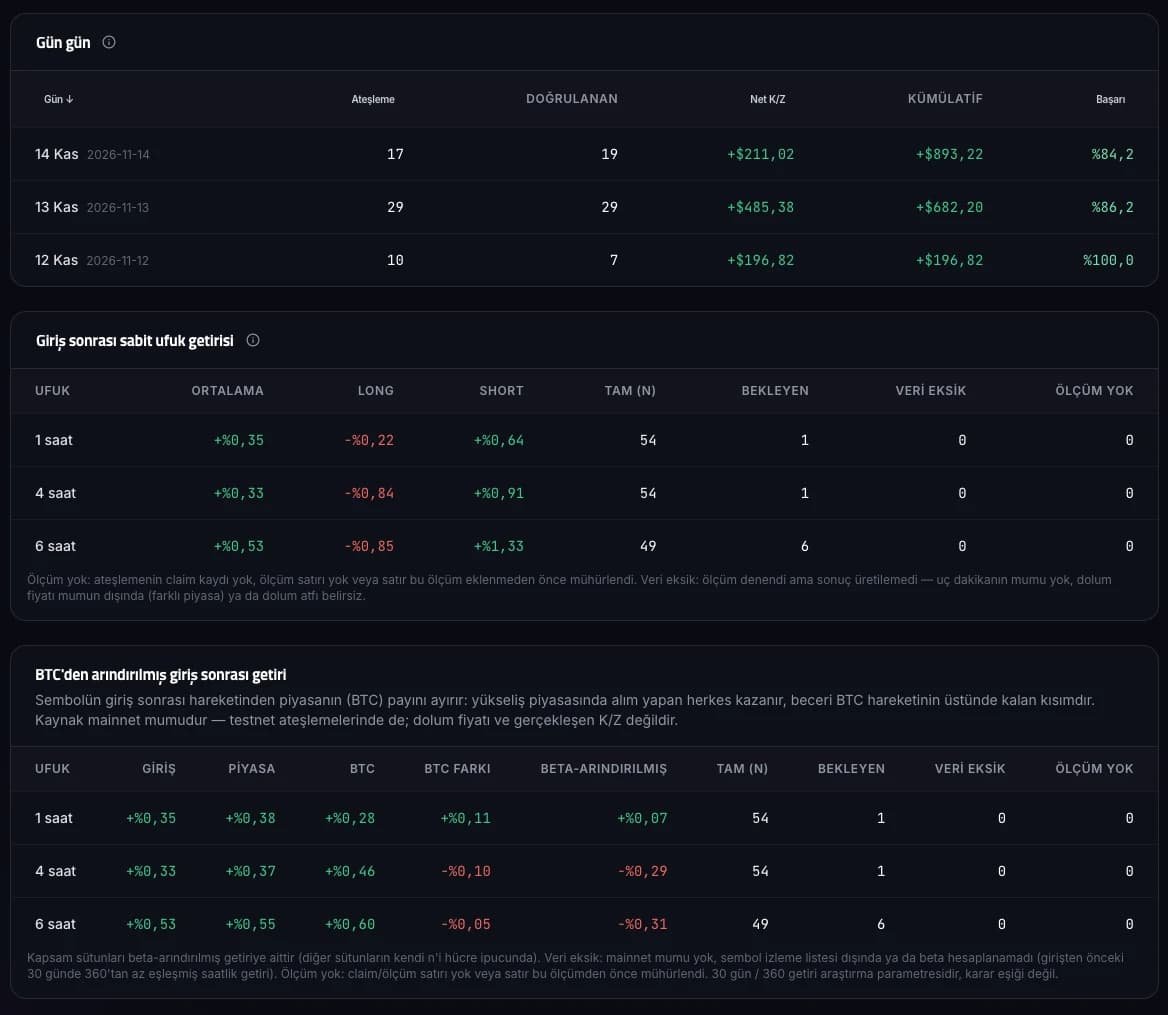
This screenshot is the clearest illustration of why I say "Month seven brought good results, and even that is not guaranteed":
- Look at the top Day-by-Day (Gün gün) table: across November 12, 13, and 14, verified hit rates sit between
84.2%and100.0%, stacking up to+$893.22in cumulative net PnL. If you stopped reading there, you would assume the system is invincible. - Now look at the two lower panels — Fixed-Horizon Post-Entry Return (Giriş sonrası sabit ufuk getirisi) and BTC-Adjusted Post-Entry Return (BTC'den arındırılmış giriş sonrası getiri). As the note directly inside the UI states: "In a rising market everyone buying wins; skill is only what remains after stripping out BTC's move."
- Notice what the numbers reveal across
N = 54measured fires: at the 1-hour horizon, beta-adjusted return stays positive (+0.07%, beating BTC by+0.11%), whereas stretching out to 4 hours and 6 hours turns beta-adjusted return negative (-0.29%and-0.31%). In plain English, our staged short-horizon Take Profit mechanics were capturing real short-term edge, while holding positions passively over longer horizons handed that edge back to broad market beta.
Without software and statistical telemetry, you mistake a favorable market wave for personal genius. With honest measurement, you see exactly where your edge lives, where it decays, and what needs refinement next.
Pro Tip
The most dangerous moment in any algorithmic trading project is winning several days in a row without knowing why. Raw PnL curves flatter luck; fee-deducted, beta-adjusted, out-of-sample measurement is what keeps your capital alive.
The Next Experiment: A Liquidation Heatmap Built for AI Direction Prediction
Earlier in this article, I mentioned that AI models are only as good as the light you hold in front of them — and that the real differentiator is building the right specialized tools for the model to interpret. One of the newest modules I have been building inside Cortex Finance comes directly out of that philosophy.
In leveraged crypto futures markets, short-term price action rarely moves on textbook oscillator crossovers alone. Dense pockets of 10x to 125x leveraged positions create forced-liquidation zones that frequently act like price magnets. A language model looking solely at standard OHLC candles is completely blind to where that trapped leverage sits. To give our AI models structured visibility for directional prediction, I built an estimated Liquidation Heatmap (Tahmini ısı haritası) powered by open interest, candle structure, account ratios, and optional tracked-wallet signals:
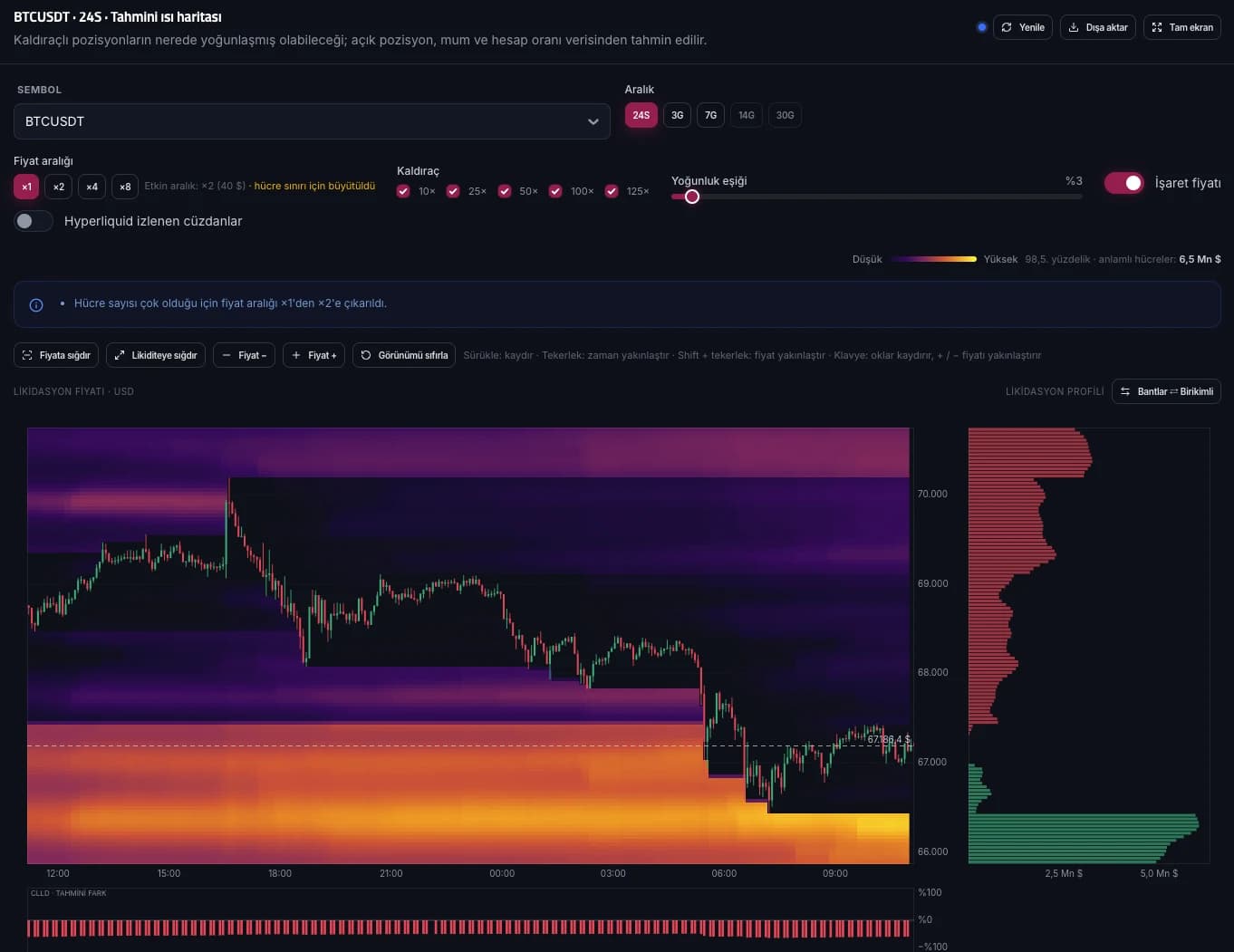
As shown on screen, across configurable windows (24H through 30D) and leverage tiers (10x to 125x), the engine maps where estimated liquidation density stacks above and below spot/mark price — such as the bright amber-gold liquidity cluster sitting around the $66,000–$67,000 zone alongside the horizontal liquidation profile bars on the right.
Will feeding this liquidation heatmap into frontier AI models meaningfully improve their directional accuracy? To be completely honest, I do not know the outcome yet either.
Seven months ago, the moment I finished coding a visually compelling tool like this, I would have assumed we had just unlocked a guaranteed edge. Today, seven months of market humility have taught me a different reflex: an impressive chart is a hypothesis, never proof. Our models will ingest these liquidation clusters, record directional calls under frozen timestamps, and face the exact same fixed-horizon and BTC beta-adjusted scorecards you saw earlier. Only when enough out-of-sample data accumulates will the numbers tell us whether the signal holds up.
The Single-Focus Requirement — and My Multi-Monitor Confession
The second major realization I walked away with after seven months concerns focus and time commitment. Online, algorithmic trading and AI agents are almost always sold under the banner of "set-and-forget passive income": write the code once, deploy it to a VPS, and let it compound while you focus on your day job.
Real life looks nothing like that. If you want to generate sustainable returns through trading, it has to be your single, undivided focus.
You cannot treat live markets as a casual Sunday-evening side project and expect durable results. Crypto trades 24/7 across shifting liquidity pockets, funding squeezes, macro headlines, and exchange microstructure quirks. Staying sharp requires full-time immersion — inspecting every closed trade, watching where triggers misfire, tracking edge decay, and constantly hardening your risk infrastructure.
And that brings me to a personal confession that still makes me smile. For years, as a software developer, whenever I saw photos of full-time traders sitting in front of four or six massive ultrawide chart monitors stacked across a desk, I quietly assumed they were doing it just to show off. In my head, if one good monitor was enough to run an IDE, a terminal, and a browser, six screens had to be pure theater.
After operating Cortex Finance against live market feeds, I finally understand why every single one of those screens is there. When you are simultaneously monitoring:
- Multi-timeframe regime shifts across major pairs (BTC, ETH, SOL, BNB),
- Real-time collateral exposure, fee drag, and protective stop distances on open positions,
- Pending triggers approaching closed-candle confirmation boundaries,
- Spot-perpetual basis spreads and funding-rate anomalies,
- Post-entry horizon telemetry, exchange error diagnostics, and model evaluation logs,
trying to cram everything into browser tabs on a single laptop screen means flying half-blind. Those walls of monitors are not vanity props; in an environment where correlated signals move within seconds, visual surface area is how operators eliminate blind spots. Judging a craft from the outside versus stepping into the arena yourself really are two different worlds.
Frequently Asked Questions
Is it safe to connect an LLM directly to an exchange wallet for fully autonomous trading?
Giving a raw conversational model unrestricted order-execution permissions is a recipe for rapid losses. In a sound architecture, the model only proposes structured plans and trigger parameters, while deterministic code enforces risk ceilings, kill-switches, closed-candle confirmation, protective stops, and dual-key live gates — validated across paper and Testnet environments first.
Which AI model performs best for trading analysis?
After testing every major provider side by side for seven months, my takeaway is clear: there is no single "magic model." Results depend far less on the model vendor and far more on the deterministic tools you attach (quantitative backtests, volatility context, news catalysts, statistical validation) and whether revisions are checked by an independent multi-model review cohort.
Can someone with zero trading experience make money using AI?
If you know nothing about market structure or risk management and expect AI to make decisions in your place, no. AI cannot substitute for missing domain experience on its own — though once you commit to learning market mechanics and pair that learning with disciplined tooling, it becomes a powerful force multiplier.
Why does software engineering skill make such a decisive difference?
Because human willpower degrades under stress and fatigue, whereas code executes the same risk check on the thousandth candle as it did on the first. Software engineering turns good intentions — waiting for bar closes, accounting for commissions, reconciling cancelled stops, and stripping out market beta — into non-negotiable system invariants.
Conclusion: That Is All for Now
After seven months of building Cortex Finance, my answer to the three-year-old question "Can AI actually trade?" is straightforward: As an autonomous decision-maker acting in your place, no; as a disciplined analytical assistant standing behind real market literacy, quantitative tools, and rigorous software engineering, it is a remarkable multiplier.
Stepping into a field I previously had zero interest in — pulled in purely because software architecture made my ADHD brain light up — taught me both the real boundaries of large language models and a deep respect for lived market experience. Seeing structured, positive results emerge at the seven-month mark is genuinely rewarding, even knowing that markets offer zero permanent guarantees and demand continuous focus.
That is where things stand for now. As Cortex Finance matures and our statistical evidence window grows, I will keep sharing what we learn along the way — and hopefully, before long, even bigger success stories too.
Artificial Intelligence Algorithmic Trading LLM Integration Cortex Finance Software Architecture